Simple site traffic statistics with django-basic-stats
django-basic-stats is my basic site traffic statistics application. It can be used to watch latest referrers, Google search terms that led to finding you site or for logging and analyzing mobile devices used to browse your site.
Testing xiQ cameras with big mono CMV4000 CMOSIS sensors for solar imaging
Big sensors were missing in Solar System photography. Big diagonal allows fitting more Moon or Sun on the sensor. That makes imaging easier and quicker. Not so long ago CMOSIS announced big 1" mono sensors. They ended up in many cameras and one of them is Ximea xiQ. It's fast USB3 based camera that can be used for high-end imaging of Sun or Moon. In this article I'll review two models - xiQ MQ042MG-CM and MQ042RG-CM.


Celestron launches Skyris planetary cameras with TIS help
Celestron and TIS announced that they are launching a set of Skyris planetary cameras. Those are fast USB3 based cameras with ICX618, ICX445 and ICX274 Sony CCD sensors. Those Celestron cameras are based on TIS USB3 cameras sold on the machine vision market.
Initial prices showed up for UK and USA. Those for Europe differ a lot from prices on TIS website for the USB3 machine vision cameras. Prices in USA match those for TIS USB2 cameras.
From those three models the mono ICX445 looks as the most interesting - this sensor is proven in solar and lunar photography. The older ICX274 sensor isn't very fast, but may be interesting to those wanting small pixels and bigger sensors to fit more Sun at high resolution (there are newer cameras but with bigger pixels, like the e2v sensors). The ICX618 model is designed for planetary imaging, although don't expect to photograph planets at 120 FPS. At max it will be 60 FPS, while on dim planets like Saturn - 30 FPS only (and there are no tests for artifacts in those USB3 fast cameras!).
At the moment there is no informations if those cameras will be supported by other apps than Celestron iCap. As it's TIS based it won't rather support fluid capture framerate or ROI (subframe) with faster capture framerate... I'll post updates if something clarify.

Debugging Python code in a browser with wdb debugger
wdb is a nice Python debugger running as a server and capable of launching debug session in your browser. It can handle simple scripts, web apps (Tornado, Flask or Django based and alike) as well as other multithread and multiprocess programs. It's easy to use and not much configuration is required.

Controlling USB missile launchers from Python
Office gadgets and toys are quite interesting and useful to those spending long hours in work. From time to time everyone wants to have a little bit of fun. In this article I'll take Dream Cheeky USB missile launcher and I'll control it from within a Python applications.
The Dream Cheeky missile launcher is quite popular and there is a lot of code available to control it. In Europe you can get it from for example hightechtoyz.co.uk (it's not very widespread). In America use the company shop.

Using analog-digital magnetic field sensor with pyMCU
A Hall effect sensor is a sort of a switch that turns on or off if it is close to a strong magnetic field (close to a magnet). It can work as a motion or rotation sensor reacting to a part that moves back and to the sensor.
There is a lot of sensor board with Hall sensor made for Arduino. I used one of available board from dx.com. You can find it also on ebay and at other shops.

Working with virtualenvs using virtualenvwrapper
virtualenvwrapper is a virtualenv wrapper that makes it easier to navigate and manage multiple envs. When you are working on different projects they all need their own virtualnenvs as they require different versions of the same dependencies if not more. To work with multiple envs the virtualenvwrapper comes in handy.
PCSL Raspberry + Gertboard open case
There is a lot of cases for Raspberry Pi. Only some of them are friendly for expansion boards. The biggest expansion board is probably Gertboard and if you search ebay you will find a PCSL open case fo Raspberry and Gertboard. I got one of those and I'm quite impressed with the design.

Introduction into CCD and CMOS image sensors
AIA channel on YouTube posted a two part introduction course into image sensors - CCD and CMOS. If you want to know more about your cameras used in astrophotography it's worth watching.
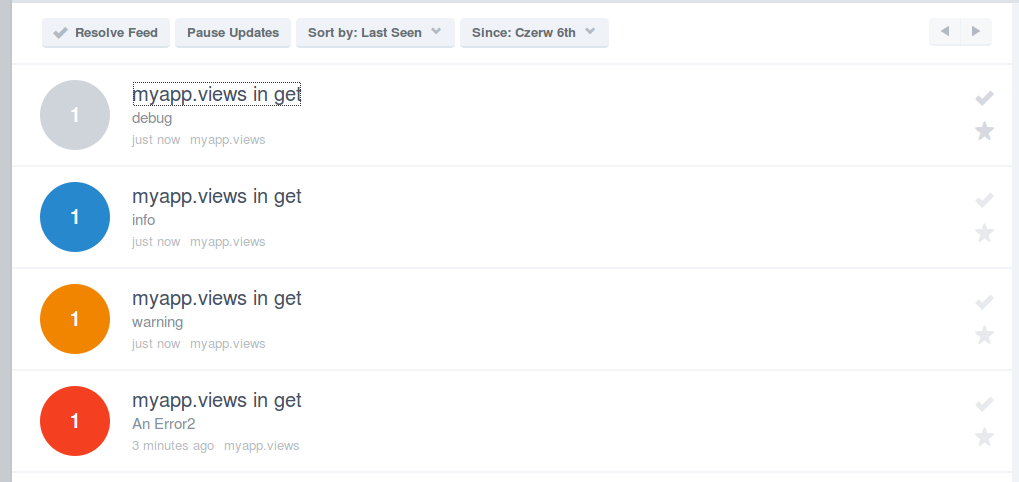
Using Sentry to log exceptions and logging messages from Django projects
sentry is something like an logs aggregation application. It can be used to log exceptions and other log messages from Django or other framework/programming languages (including JavaScript). Instead of sending a lot of emails to a project admin Django will send them to Sentry which will aggregate them and present in a readable form. Sentry is actually a Django application that can be launched setup on your local computer - perfect for testing.
In this article I'll show you how to run Sentry on your local computer (basic setup) and how to configure Django and other parts of the Python code for optimal Sentry logging results.