Is there a new planetary imaging revolution rising?
You don't know when, but it will happen again - a newer sensor will beat nowadays cameras used for Solar System imaging. Few days ago e2v revealed a new line of Ruby CMOS sensors that have very low read noise and high QE. One of them has also a global shutter required for efficient planetary/solar/lunar imaging. That's something for the future, while Sapphire "EV76C560" sensor is also on a rise. e2v is a company that provides professional sensors even for space probes. Will their CMOS sensors conquer planetary imaging?

Powerful modern imaging sets for planetary, lunar and solar imaging
Imaging sensors are quickly evolving to provide better and better performance for demanding markets. Thanks to that evolution planetary, Lunar and Solar imaging is able to do better and better images or to do images never ever possible before. Last year was the year of a total domination of Sony ICX618 in the planetary imaging. A successor to the old ICX098 used in Philips webcams and older planetary cameras. It offers much higher sensitivity and better speed performance. In the category of Lunar and Solar imaging there is no dominant sensor, but Sony ICX445 is taking the lead. It offers better sensitivity than competing ICX204/205/274 - especially in infrared which is imported for H-alpha solar imaging.
Taking in mind the latest cameras and accessories, here are my propositions for effective Solar System imaging setups.


How big a camera must be to catch the whole Sun in one frame?
When doing Solar imaging with a solar scope people usually want to catch the whole Sun in one frame. Depending on the scope focal length a big enough imaging sensor is needed. But how big should it be. Here is a set of sensor diagonals for given (Lunt) focal lengths.
Small, cheap and good cameras for planetary and lunary imaging
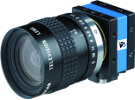
Some time ago I reviewed Point Grey Chameleon camera - it's small, cheap and quite powerful. On the machine vision market there is more similar cameras combining relatively low price with good performance. Here is a list of such cameras...
Lunar petrographic imaging - showing minerals and age in colors
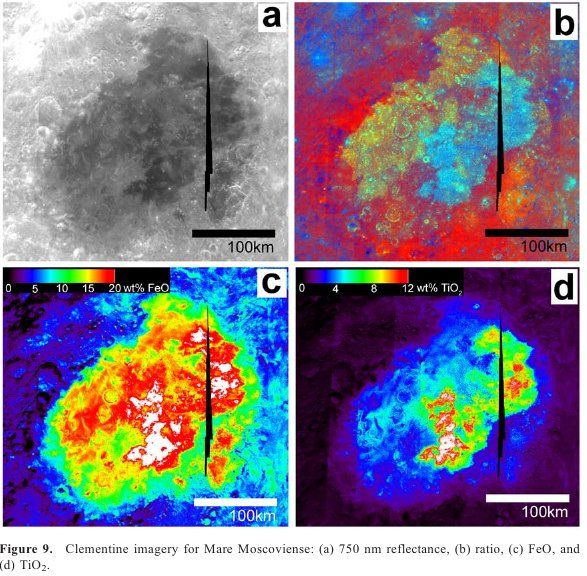
Amateur Moon images may be razor sharp but they usually are gray... Except of trying to increase color intensities on a standard color image there are other ways of making colorful Moon images that will also showcase differences in the surface composition or age. Petrographic photography uses specific bands to catch absorption bands of minerals present on the Moon. This is quite unknown subject for most of astrophotographers. In this article I'll describe techniques developed by professionals for the Moon.

Cheap and interesting filters in Edmund Optics shop
Edmund Optics has a huge sale for narrowband (bandpass) filters from uv, visible and infrared range. Those filters are priced much lower than average bandpass filters of such capabilities, but still they don't offer very high transmission.
What can be done with those filters? Experiments. You can match filter to helium or neutral oxygen bands. You can also try comet imaging with narrowband filters catching C2 emission at 514/511 nm or CN at 388 nm. Gas planets have a methane absorption band at 889 nm. Venus shows some cloud structure at 418 or 986 nm and in UV 350-370 nm. At 1010 nm you can try catching night side heat glow...
For astrophotography the 24,15 mm dia filters will be best. They need a 1,25" filter cell. For thin (max ~5 mm) filters plastic SkyWatcher Moon filter cells can be used. For those and thicker ones custom cells can also be used. Gerd Neumann can mount them in single or double Astronomik filter cells. If it's double cell then it won't fit in (nearly?) any wheel so you probably will also need customized Gerd filter drawer. There is also T2 holder for thin and thick filter.
Filters of 24,15 mm diameter will work with up to semi-sized sensors like 2/3" ICX285 in Atik 314L+ and alike. Bigger sensors like KAI-4022 in Atik 4000 with a 23 mm diagonal will have some vignetting.
But there is more... A filters that glow! Lumilass filters absorb UV radiation and glow in red, green or blue band - it's fluorescence glass. Green Lumilass has such spectral performance:

There are no astronomical case studies for such filters, but for CCD cameras QE is very low in ultraviolet (unless you have a UV specific camera). So it could allow much better UV performance for average cameras with scopes that don't absorb UV.
For managing IR lasers there are also phosphor coatings (phosphor coated CCDs or glass "filters") that convert for example 1550 nm to IR wavelengths that are within CCD/CMOS range). That doesn't seems to be cheap (1-3K EUR), but still much cheaper than an InGaAs SWIR camera. Phosphor converters (available in EO) are also astro-untested.
Two crazy CMOS sensors with unique features
Let start with something very odd. New Imaging Technologies is offering CMOS sensors that don't have a linear response. Instead they have logarithmic response which allows them to achieve more than 140 dB of dynamic range (which is more than twice what standard cameras have). In logarithmic response strong signal isn't as strong to a weak signal when compared to a linear sensor. Watch this video:
It doesn't have an exposure time (odd) and it's hard to tell if it would be usable in astrophotography. Maybe bright-dark cases in planetary imaging (night side of Venus, Saturn in methane band, Uranus rings in IR, Earthshine on the Moon...).
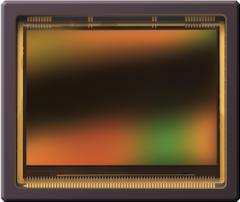
CMOSIS got attention of some solar imagers as it offers big mono CMOS sensors with global shutters (2/3" and 1"). CMV2000 and CMV4000 will be available in GigE Baslers cameras in Q1 2012. But CMOSIS did launch something new and very very big CHR70M - 70 mpix, 10000 x 7096 frame (3.1 x 3.1 µm pixels, ~35 mm diagonal, 3 FPS at full frame, more with ROI). It has FOV nearly as big as Atik 11000! Maybe it could be usable for some sky surveys? It would also give nice resolution at short focal lengths.
Pystacia - image manipulation library for Python
Pystacia is "yet another" image manipulation library for Python... but it has some advantages over other libs:
- Python API, expendable by subclassing
- Wide Python support - 2.5, 2.6, 2.7, 3.1, 3.2, PyPy and IronPython
- No compiler required, just "pip install pystacia"
- Works on 32 and 64 bit MS Windows, Linux and on Intel based OSX
- Inner 16-bit per channel precision
- Multithreaded processing on multiple cores
- MIT license
- ...and more ;)
Point Grey Chameleon - lunar and solar camera
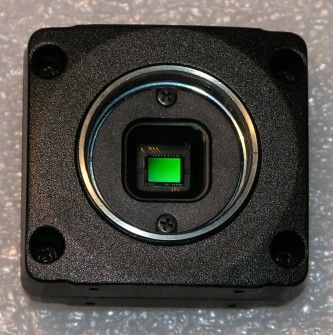
Point Grey Chameleon is a very small USB camera. Even so it has great capabilities. It's quite cheap and it's equipped in one of the latest Sony CCDs - ICX445. You get 1296 x 964 frame with small 3.75μm x 3.75μm pixels (colour or mono). It's a very good lunar and solar imager, much better than DMK31 and 41.
Catching Jupiter inner and outer mini moons
Jupiter has a lot of small moons. Some are very close to the planet, other are on quite big orbits. They are very faint but amateurs may catch then on photographs without sophisticated equipment... lets start from the inner moons.


