TSFlip - Flip Mirror and Off Axis Guiding System in one device
TSFlip is a new device made by Teleskop Service. It's a combination of an Off Axis Guider (you can guide the DS imaging setup using a star from the edge of the field of view) with a Flip Mirror - you bounce the image up to the guide head and see it with an eyepiece (to find and center the object you are looking for).

Testing IDS Imaging UI-1245LE-M-GL camera in planetary, lunar and solar astrophotography
Few days ago I acquired from optosoft a UI-1245LE-M-GL camera made by IDS Imaging (UI-1240LE-M on their site). This camera can be a general purpose - planetary, Lunar and Solar imaging camera.

My filters and first results of lunar petrographic imaging
Some time ago I wrote about petrographic Moon imaging. I managed to collect a set of quite cheap filters for this type of imaging using eBay and Edmund Optics shop. In this article I'll present those filters and some first results I got - and do look to be correct.

Cheap USB 2.0 webcams are quite disappointing
Microsoft LifeCam HD webcams get the best reviews in the webcam category, as well as get a lot of attention from amateur astrophotographers wanting something cheap for planetary and Lunar imaging. Lifecam Studio has 2 Mpix OmniVision sensor and is the biggest webcam in this line. Recently webcam market got flooded by cheap multi-branded webcams than on the box have the same specs - 2Mpix and USB 2.0. They are cheaper than Lifecams... but are they usable for astrophotography at all?
I did a quick check by testing Canyon CNR-WCAM820 and Esperanza EC103 webcams - both described as USB2.0 and having 2Mpix sensors. The results are quite disappointing.

Making HDR images of deep space objects in IRIS
Imaging some DS objects like M42 - the Orion Nebula overexposing some areas is nearly inevitable. In M42 bright trapezium region is easy to overexpose when catching the much fainter nebulosity around it. In post processing its however possible to correct this problem by using not overexposed trapezium region from an image made on much shorter exposure. Such images are quite often called HDR image - high dynamic range.
HDR images are made out of 2 or more images of the same area - each image on different exposure time to catch either faint or very bright areas. Combining them in to one HDR image can be done in multiple apps, like Photoshop but those are not free. IRIS however is free and has a ready to use feature that will merge all images into a HDR image.


Planetary, Lunar and Solar image stacking in Autostakkert2
Autostakkert 2 is a new version of a popular planetary stacking program. The new version brings a lot of improvements as well as new features like support for surface stacking - Lunar and Solar AVIs.
In Autostakkert 2 you open your AVI files, tune the application settings, select the alignment area and you start stacking. Multiple planetary AVIs may be stacked in one run. For surface AVIs you need to configure and stack one AVI at a time (no batch support)...
ASCOM for end user application developers
ASCOM is a nice platform providing unified access to astronomical hardware controllable from a computer. Hardware makers provide ASCOM driver and end user apps like PHD or Nebulosity may start using it without problems or additional drivers. For developers - those that want to make drivers or use the ASCOM API - the journey to ASCOM starts at digging through raw documentation. Some help may be found also on the mailing list. It's not documented as well as Django, but still - it's usable.
MyghtyBoard 2012 first beta available - a simple and handy Django forum application
After a long time I've found some time to release the current version of the forum app I'm using. It's named "MyghtBoard" and the test-version looks like so:
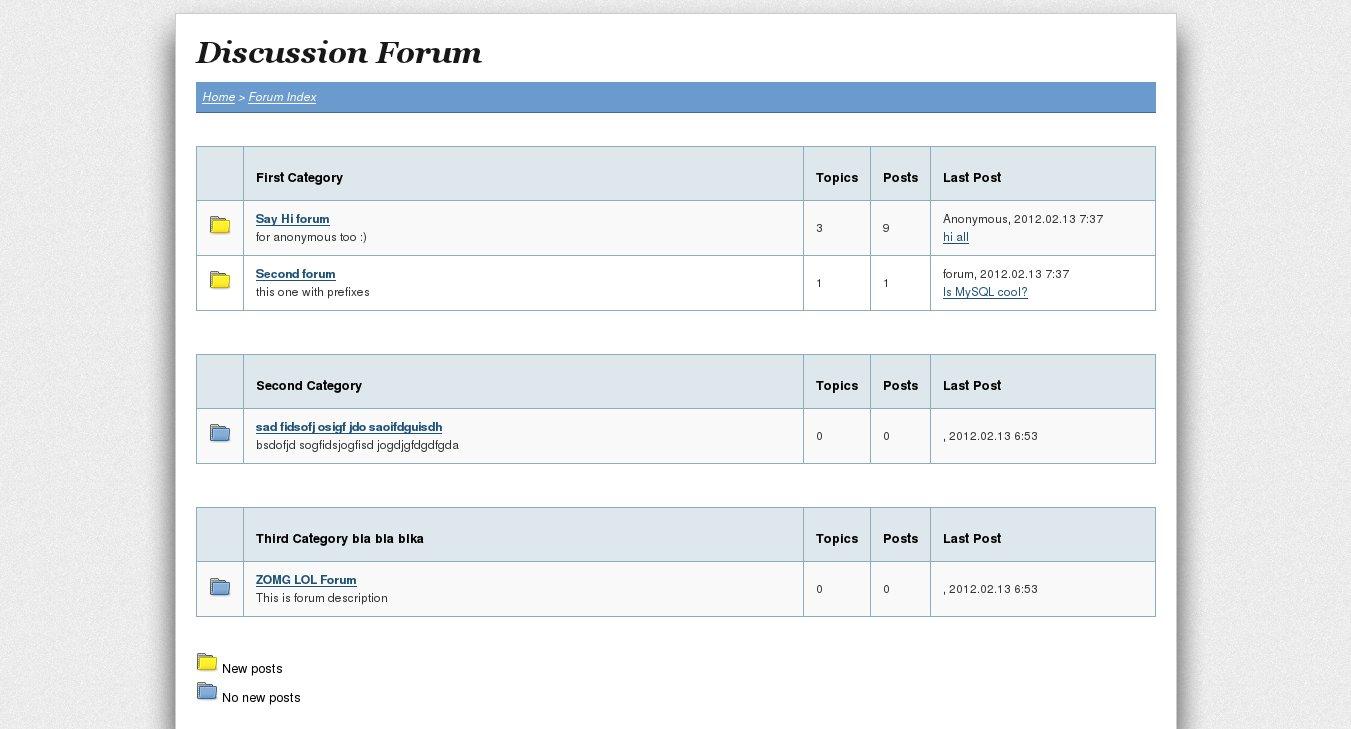
You can download the code from the project site either from ZIP file or from SVN. This is a first release after a while so it may contains some bugs.
The application consist of forum categories, which contain forums. Each forum has its own topic and topics have posts. Topics may also be global - shown in every forum, or sticky - always on top of the forum. Forums may also use tags - admin selected tags that users will be able to choose for their topics (or filter topics by tags). Topics may be moved to other forums, locked/unlocked, solved/unsolved and so on...
Astrophotography, imaging sensors and machine vision
Amateur astrophotography started long ago when Philips webcams - Vesta, Toucam, SPC900 became widely available. At that time they were unique - with a Sony ICX098. Those webcams were quickly adapted for planetary imaging, and after hacking the electronics - for long exposures needed for DS imaging...
Nowadays there are dedicated cameras for every type of astrophotography, astronomical spectroscopy or photometry. So called "amateurs" usually want to get a good image of given objects. They don't use the most advanced and most expensive equipment available. Sometimes they hunt for cameras not designed initially for astrophotography of any kind...
Solar H-alpha imaging and observing with a 35 mm Lunt
Lunt is known for its solar telescopes. I got one of them for a test - the smallest from H-alpha Lunts - 35mm Deluxe. It's a scope for observing and imaging the Sun in the H-alpha band. There are actually two 35 mm Lunts - standard and deluxe. The Deluxe version comes with few extras: solar finder, dovetail with rings, eyepiece and slightly wider blocking filter in the diagonal. Here what's in the box:

35mm Deluxe Lunt set


