PySide 1.0.3 is working nicely
Some time ago initial PySide releases wasn't able to run apps written with PyQt4 "just like that" with only few changes to the code. I've tested current 1.0.3 release with my quite simple App - "Zbrojownia Albionu" and I've managed to get it working with PySide quickly.
PySide is a Python library for Qt4 released under LGPL license. PyQt4 is released as GPL or paid commercial license. The more libre LGPL license is in the scope of interest for some closed source apps.
Audio recording in Django apps with flvar
flvar is a flash applet working with a media server and allows users to record audio clips on a website using it. To use it in a Django project you need to setup the media server like Red5, and map some hardcoded paths in flvar recorder to Django views and templates.
Planetary imaging with atmospheric dispersion corrector
A quick run with atmospheric dispersion corrector and Meade TeleXtenders on Saturn. The corrector allowed to get superb luminance images and true LRGB images.
Helium, argon, neutral oxygen and other bands in narrowband imaging
Quick look through exotic bands for narrowband imaging of planetary nebulae with amateur equipment.
New entry level camera - Brightstar Mammut Lyuba L429
astroshop.de introduced a new CCD camera - BS Astro Lyuba L429. It is equipped with ICX429 (as in DSI II or QHY6 Pro), 16-bit A/D, active cooling and ST-4 guide port. The sensor has very high sensitivity, but it is interlaced (thus not recommended for short exposures in planetary/lunary astrophotography). It costs 500 EUR which is much lower than very similar QHY6 Pro.

Point Grey tests the big CMOSIS CMV4000 sensor
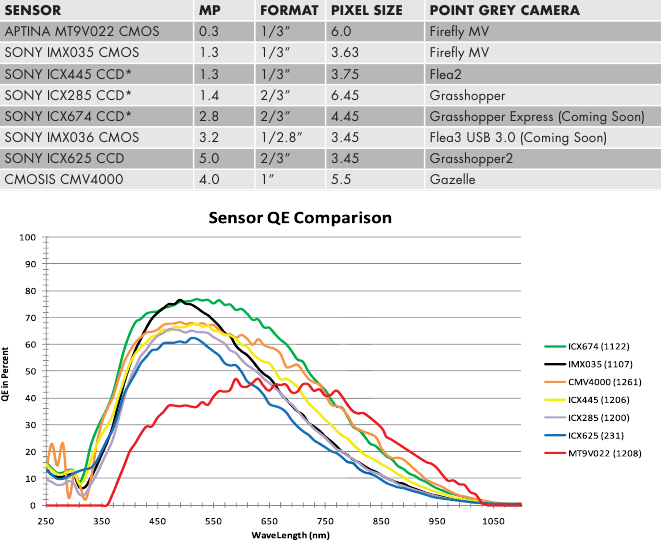
Point Grey added QE spectral chart for the 1" CMV4000 CMOS sensor made by CMOSIS to their latest comparison document:
New solar system cameras in action
Heel Korbinian presented few images of Saturn and DS objects that he took with QHY IMG0H equipped with ICX618 CCD and Peltier cooling. The images are of high quality and doesn't show any signs of artefacts that are present in older designs.
More and more H-alpha solar images are made with Point Grey cameras. The press release describes advantages of those cameras as well as presents some fantastic results. Cameras like DMK31/41, Lumenera 2.1, 2.2 equipped with old non-exview CCDs: ICX204, 205, 274 are loosing the ground as they have much lower sensitivity in H-a, and lower dynamic range (DMK). Point Grey cameras have a wide selection of ExView CCDs like ICX445, 285, 625, or even fresh from Sony ICX674. TIS D*K cameras lost so many users and the interest in new CCDs is so high that the company decided to work on an upgrade for all (?) of their cameras.
Baader sets 645 EUR for SBIG ST-i
Looking through Baader catalogue I've found the incoming SBIG planetary/guide camera ST-i priced at 645 EUR (mono or colour). This camera is equipped with Kodak KAI-340 CCD, which would be the first Kodak based "planetary" camera. The sensitivity is quite high, but not as high as currently used Sony ICX618. At 645 EUR ST-i would be the most expensive planetary camera (Basler Ace around 100 EUR less). At the moment there is no tests or reviews of this camera, and to be worth it SBIG camera must have very high gain (like in Basler, TIS cameras) and very high S/N ratio (like in DS cameras) as it's very slow so few frames must suffice.

Saturn imaging tips
How to catch best Saturn images with webcams or dedicated planetary cameras.
Long exposures for Basler Ace
In the upcoming release SharpCap will support long exposures for Basler Ace cameras. This is done by using software timers to control exposure time, bypassing camera built-in limitation of 1 sec exposures (for the 640gm). However long exposures show quite high noise levels:


