PointGrey Blackfly - a new handy camera
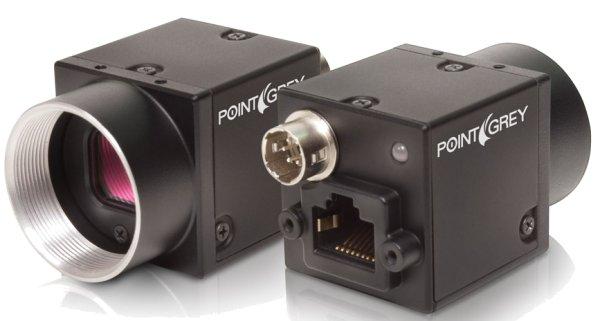
PointGrey revealed a new camera called Blackfly. It should be released this year and should cost $395 or 299 EUR. It's a GigE camera - meaning that you connect it to an Ethernet card with an Ethernet cable - and nearly every laptop or PC has an Ethernet (network/Internet) card.
This camera can be very handy in Solar System imaging. It's based on already tested e2v EV76C560 CMOS sensor. It has a quite big diagonal - 1/1.8", and good pixel size - 5.3 μm. Full 1280x1024 frame can be recorded at whooping 60 FPS. With small sub-frame it should be even faster. The sensor is probably locked to global shutter (it also has rolling shutter with lower read noise, but plausible artifacts when the image isn't stable).
Big diagonal will be handy for solar imaging where it will cover whole Sun from small solar scopes. It will also cover a lot of lunar surface. As the performance of this sensor is quite good it also can be used for some planetary imaging. EV76C560 is not the latest e2v sensor, but it's quite cheap (as newer one showed up). This sensor is available in multiple cameras. I tested IDS Imaging UI-1245LE-M-GL and Ximea xiQ MQ013MG-E2. It was also test on astrosurf in solar H-alpha imaging.
So we can get a fast and affordable multi-purpose Solar System imaging camera. And for people wanting more - newer e2v sensors - EV76C661 and EV76C660 sensors should show up in new cameras too.
Features of FireCapture 2.2
FireCapture is in active development and new versions bring new interesting features. At the moment beta versions of FireCapture 2.2 are available. Latest releases of this application for planetary imaging can handle electric filter wheels, motofocusers or even do self-guiding on a planet. In this article I'll show what FireCapture has to offer.
Scripting Ximea machine vision cameras in IronPython
Ximea machine vision cameras are handled via XiAPI. The API is implemented for the .NET platform. In this article I'll present a IronPython scripts that will use the .NET API to control the Ximea xiQ camera.
IronPython is a Python implementation on the .NET platform and as such it can use any .NET libraries and resources.
REST API creation with django-tastypie
django-tastypie is probably the best at the moment tool for REST API creation in Django applications. The code is on github and documentation is on readthedocs.org.
With tastypie it's easy to create REST API that will allow easy web access to data stored in models - get, update, edit or delete. In this article I'll show some basic usage of tastypie.
Testing fast USB3 camera - Ximea xiQ MQ013MG-E2
Ximea xiQ MQ013MG-E2 is the first model of USB3 machine vision cameras offered by Ximea. Thanks to the fast USB3 interface this model can record 1280x1024 frames with the speed of 60 frames per second. The whole set is priced at around 330 EUR, which makes it very very hot camera. In this camera I'll test and describe this camera and its capabilities.

PGR FireFly 0.3 cameras gain new users
PGR Firefly cameras are still available on ebay.com. New images of planets, Moon or Sun taken with those cameras are starting to pop on the web. Some of then can be found on astro-blog.pl. If you want to use the PGR Firefly 0.3 for guiding you need to install FlyCap 1.X, but the camera is limited to 0,5 sec exposures. To overcome this limitation French astronomer wrote an ASCOM driver offering more efficient exposure mode. You can download it from webastro.net.
New WinJUPOS release with field rotation compensation
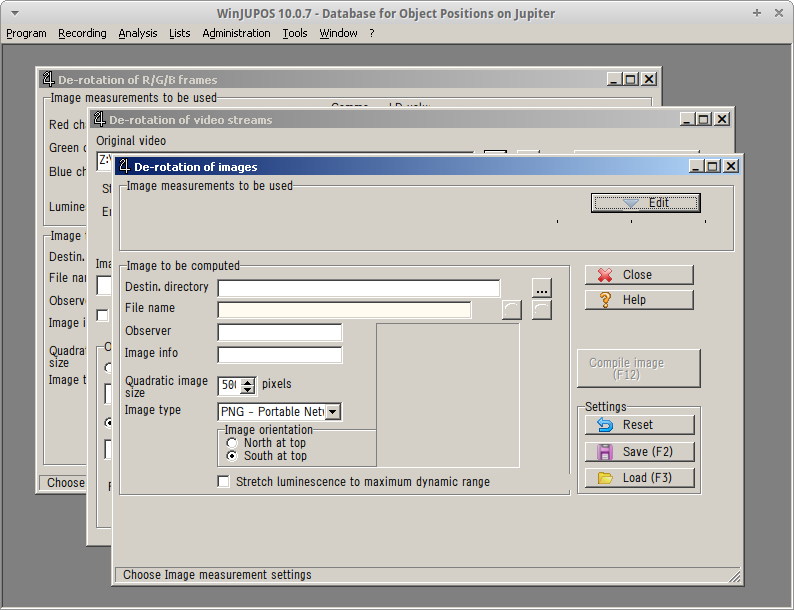
Last week a new version of WinJUPOS have been released. The new version 10.0.7 aside of standard fixes and improvements can now compensate also for field rotation that will show up on longer recordings when the telescope is on an alt/az mount.
At the moment WinJUPOS can create RGB and LRGB images with planet rotation compensation. It also can compensate for the rotation on a given AVI or image set. With the latest version it also can handle field rotation. This tool is very handy for Jupiter image processing where planet rotation is fast and easily visible on detailed features present in planet atmosphere.
Aside of image processing WinJUPOS offers a nice set of ephemerids, observation planning and analysis tools.
Aiding tests with Ludibrio stubs and mocks
In tests we assume some input data and check if the output is equal to what we expect it to be. Sometimes is impossible to set the initial data as the code fetches some data from a third party API, or creates some data on its own (like random data). To aid testing of such code we can use ludibrio. It can mock or stub existing classes or functions making them work as we program it.
Very very very big sensors for lunar and solar imaging
CMOSIS CMV2000 and 4000 sensors didn't entered the market yet (in USB3 or GigE, Firewire 800 cameras) and even bigger sensors got announced. On cmosis site we can find informations about CMV12000 - a mono sensor with an APS-like diagonal (almost like in a DSLR - Canon etc.). CMV20000 is even bigger - 35mm diagonal. If you have a very big focal length and you want to avoid mosaics of the Sun or Moon such sensors may be a solution. 1" CMV4000 is priced around 700 EUR, CMV12000 - 2500 EUR, CMV20000 - 4000 EUR. Upcoming Basler and Ximea cameras with CMV4000 were initially priced around 1200-1800 EUR.
Two new cameras for solar system imaging
Last week I got two new cameras to test and use. Ximea xiQ (the small one below) is a USB3 fast machine vision camera equipped with e2v EV76C560 sensor (which I reviewed earlier in an IDS Imaging camera). The USB3 interface allows 1280x1024 at 60FPS capture. The base price for a camera set is around 333 EUR (camera, industry grade USB3 cable, USB3 PCI Express adapter). At such low price this camera is a real killer for solar and lunar imaging (planetary too).
Second one (the bigger black one below) is Tucsen sCMOS camera called Discovery M15. It's a real sCMOS sensor with a low price (around $405 plus shipping and duties). The sCMOS sensors has a low read noise of 3e, and quite good QE. Low read noise is very important in planetary imaging - as it's the main source of noise on short planetary exposures.


